
 “I could never reconcile my conscience to convict this accused on the type of evidence offered here.” – Justice Charles P. McTague’s instructions to the jury, following the closing statements of prosecution and defence in the trial of Vernon Spencer, April 1938.
My friend Larry was aghast at the judge’s audacity. As a former and long-serving Crown Attorney (Canada’s equivalent to District Attorney), Larry was my go-to for all things legal as my co-author Amanda Capper and I researched the murder of Helen Grier at a remote hunt camp in Northern Ontario, Canada. The accused, Vernon Spencer, affluent Michigan dairy farmer, former pro baseball player, and married father of two, had discovered Helen’s body on October 28, 1937, after an afternoon of purportedly looking for moose tracks. The cause of death: a bullet wound to the brain.
“Whether the Crown (prosecution) proved their case beyond a reasonable doubt was up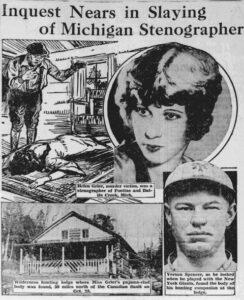 to the jury to decide,” Larry wrote. “I cannot imagine such an instruction would be delivered today.”
Spencer was acquitted of Helen’s murder after a scant three hours of jury deliberation. Was their decision based on the Crown’s failure to meet the burden of proof or unduly influenced by Justice McTague’s final words? In writing A Fatal Affair: The Murder of Helen Grier, Amanda Capper and I made no such assumptions, nor did we offer any personal opinions. From the get-go, we had agreed that Helen’s story would be told without bias, as accurate a representation of the events as we were able to assemble based on available historical archives and newspaper articles.
When it came to newspaper articles, we were lucky. The combination of murder, Spencer’s former pro-athlete and societal celebrity status (his wife, who stood by her man throughout his ordeal, was the daughter of a wealthy Los Angeles financier), along with the possibility of a scandalous affair, had been irresistible to press and public. A plethora of newspapers on both sides of the border covered (often in salacious detail) the investigation, inquest, and subsequent murder trial. A subscription to newspapers.com, an online archive of hundreds of digitized newspapers, proved to be worth its weight in gold. Even more invaluable was the 100+ pages of letters and legal documents from the Ontario Office of the Attorney General, obtained with permission from Archives Ontario.
 Sadly, records of the actual trial were no longer available. Too many years had passed, and the facility where they might have been stored had experienced a flood several decades earlier. Nonetheless, Amanda and I felt well-versed in the world of lawyers and trials. After all, our legal “education” had been honed on years of watching Law & Order.
As you can imagine, Larry quickly set us straight. “The U.S. justice system,” he informed us, “is far different from that in Canada, especially 80+ years ago.” The sentiment was echoed in Justice McTague’s parting words to Mr. Spencer upon hearing the verdict of “not guilty.”:
“I haven’t any sermon to deliver to you, Spencer at all. It is a time-honoured custom which I do not follow. I only hope that as an American you realize our juries are still handing out British justice. It is a term that needs no explanation. You will now be dismissed.” 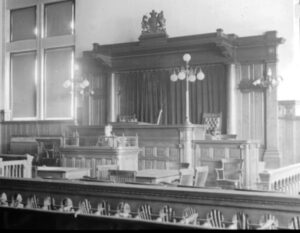
When asked by a Sault Daily Star reporter for his thoughts on “British justice,” Vernon responded with, “I will say this, it is certainly fair.”
Was the verdict fair? Or did the jury get it wrong?
You be the judge.
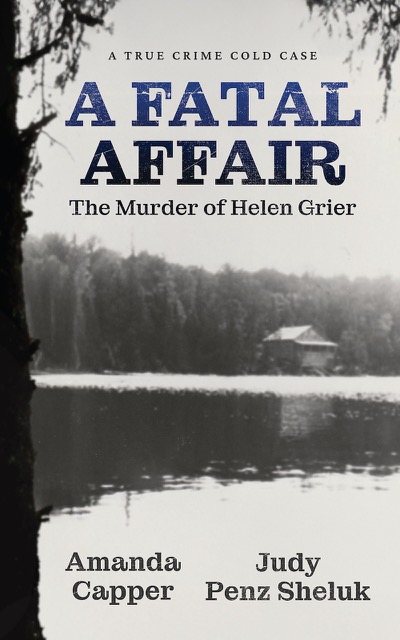
About A Fatal Affair: The Murder of Helen Grier: On October 28, 1937, at a remote cabin in the Algoma District of Northern Ontario, the body of 28-year-old Helen Grier was discovered by her lover, Vernon Spencer. The cause of death was a bullet to the brain.
A married father of two, Spencer, 43, was held as a material witness for 71 days before being charged with Helen’s murder. A gruelling six-day trial in Sault Ste. Marie followed. Vernon Spencer was acquitted after a scant three hours of jury deliberation.
Was the jury wrong? Did Vernon Spencer, former professional baseball player and Michigan dairy farmer, get away with murder? Could it have been someone local who dropped in to visit and found the pretty young brunette alone and vulnerable? Or is it possible, as was suggested by Spencer’s defence team, that it was Helen Grier who fired the fatal bullet?
You be the judge.
Available in print and e-book at multiple booksellers. www.books2read.com/afatalaffair .

About the Authors: A former journalist and magazine editor, Judy Penz Sheluk is the multiple award-winning author of seven bestselling mystery novels, two books on publishing, and several short stories. Amanda Capper is a writer of short fiction, and the author of the “Maybe” mystery series (coming 2027). Learn more at judypenzsheluk.com and amandacapper.com .
Image Credits
Judy Penz Sheluk
Amanda Capper
Cover art
Prisoner’s Dock: In the 1930s, and still today, albeit to a lesser extent, the accused was seated in a Prisoner’s Dock, a box situated directly in front to the judge. There was no consultation with defence council. Courtesy Archives Ontario.
Newspaper-1: This photograph of Helen and Vernon was used by multiple newspapers on both sides of the border, with varying headlines.
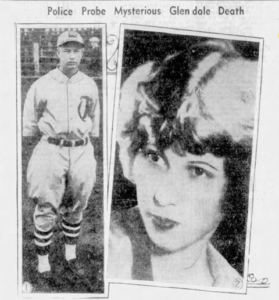
Newspaper-2: One of the more sensationalized images found in the news.